Tuesday, October 1, 2013

A Good Read From Highpoint


A Brief History of Printmaking
Compiled by Highpoint Center for Printmaking
Printmaking has shaped culture in all parts of the world. Originally used as a form of communication, printmaking is now valued as an artistic medium with unique technical qualities. To make a print, the artist typically creates an image on a surface made out of metal, stone, wood, or other materials; the surface is then inked, and pressed onto paper to create an original print. By repeating the printing process, the artist is able to create multiple original works of art.
Printmaking has its roots in prehistoric times, when humans placed their hands on cave walls and blew pulverized pigment around them to create images. In approximately 500 BC, Sumerians carved images on cylinder seals that could be pressed into wet clay, thereby creating multiple imprints to indicate the ownership of goods. Chinese scholars created rubbings from carved texts around 200 AD, an early form of printing that could be done on paper and silk.
The invention of paper set the stage for printmaking throughout the world, because paper was affordable and well-suited to printing. As papermaking knowledge spread from China to the rest of Asia, the Middle East, and Europe, printmaking became more widespread and technologically sophisticated.
Printmaking initially flourished as a form of communication, for it enabled artists to make multiples that could be disseminated to a large number of people. Starting in the eighth century, Japanese artists used printmaking to make multiple editions of Buddhist manuscripts. In fourteenth century Europe, woodcut prints became a popular way to distribute Christian images to the common people. In the fifteenth century, Gutenberg’s printed Bible ushered in a whole new era of literacy.
From the Renaissance onward, individual artists became known for their spectacular use of printmaking. Albrecht Dürer dazzled fifteenth century audiences with the exquisite detail and consummate craftsmanship of his paintings, woodblock prints, and engravings. Two centuries later, Rembrandt’s mastery of the intaglio medium enabled him to create an influential group of over three hundred printmaking plates. About the same time, Japanese artists such as Katsushika Hokusai took the art of woodblock printing to new heights. Over time, the “toolbox” of printmaking techniques expanded to include etching, mezzotint, and eventually lithography, silkscreen, and monoprint. As processes became more complex, more artists began to work in printshops with professional facilities and the expertise of a Master Printer.
The late nineteenth century saw the rise of the artist-printmaker in Europe and the United States. Whether working independently or collaboratively with Master Printers, these artist-printmakers helped to firmly establish their medium within the artistic canon. Seminal figures within the nineteenth century include Turner, Whistler, Blake, Degas, Cassatt, and Goya. Artist-printmakers in the first half of the twentieth century include legends such as Chagall, Matisse, Munch, Picasso, Miro, Arp, Ernst, Dali, Kollwitz, Beckmann, Barlach, Kandinsky, Klee, Hopper, and more.
In the same time period, artists all over the world carried printmaking to new heights. Japanese artists, for example, worked within the established tradition of ukiyo-e printmaking to create lumious woodblock prints depicting scenes from mythology and everyday life. In Mexico, artists such as José Posada flocked to printmaking for its graphic beauty and potential to effect social change. The famous Mexican Taller de Gráfica Popular (Workshop for Popular Graphics) provided access and inspiration for an entire generation of artists.
Contemporary artists continue to use printmaking for its unique visual qualities. As today’s artist-printmakers work with time-honored hand processes, often in communal printmaking workshops that foster collaboration and innovation, they build on the rich traditions of their artistic forebears.

Thursday, September 19, 2013

Advanced Printmaking

The advanced print group is well on the way exploring many avenues of expression. Alex is body-stamping on curved sheets of glass and contact paper; Angie is looking at photoploymer plates for both intaglio and relief; Chasson started with intaglio and plans to move into monotypes and possibly relief; Emily is printing relief and then pasting the images around town, and Rebecca is getting her feet back into the process after a two year hiatus, starting with intaglio. Here are their beginnings:


Alex


Chasson


Rebecca


Angie


Emily

Fall 2013, Printmaking Basic Media

A new semester has started in the printshop. We started the learning process with three-color separation monotypes, getting everyone acclimated to the shop, the press, and the idea of building imagery with layers. There were some strong responses to the process and some engaging explorations into color, texture, line, and value. Some examples:


Amelia


Ashley


Christina


Dustin


Kaitlin


Kathleen


Kathryn


Katy


Maho


Tamara


Tre


Zane

Monday, November 19, 2012

Oscar's return visit

Oscar has decided to incorporate two more plates into his engraving, so he is back home in Peroria completing the mezzotints that will carry the lush colors (looking forward to the Oscar Red). He'll return on December 1 and 2 for a print-a-thon in the shop with the usual band of Rolling Knob Press printers. We're all pretty excited about that. We learned so much while he was here, so everyone is working on engravings and mezzotint collagraphs to keep the momentum going. Thanks, Oscar, and we'll see you in a few weeks.

Thursday, November 15, 2012

Oscar Gillespie's Visit

Oscar has been working in the shop all week, cutting away on a large zinc plate that's polished to a jeweler's perfection. He's also taught my students how to engrave and many are cutting away on their plates. Yesterday he presented his work and influences to about 50 students and faculty. It's been a busy week so far.


Oscar is preparing copper plates to so that color can be added to the engraving he's been working on. The proof below is where the plate was yesterday afternoon, but there has been a lot more cutting since then so I suspect that it's much more lush with Oscar's distinctive line work.


Engraving is the practice of incising a design on to a hard, usually flat surface, by cutting grooves into it. The result may provide an intaglio printing plate line work for printing images on paper as prints; these images are called engravings.

Engraving was a historically important method of producing images on paper, both in artistic printmaking, and also for commercial reproductions and illustrations for books and magazines. Partly because of the difficulty of learning the technique, is much less common in printmaking today. However, traditional engraving, by hand with a burin, continues to be practised by goldsmiths, glass engravers, gunsmiths, and Oscar Gillespie!

The works below are examples of Oscar Gillespie's print work that he has shown to numerous students and faculty during his visit. These are only a few of the many prints he brought with him to share. 


This engraving with aquatint (maybe even some mezzotint) has the intense "Oscar-Red" that adds a very unique quality to his work.


The above reductive relief print was a demonstration impression that Oscar created for his students. I was glad that he brought it with him as my beginning students are currently working on relief prints, so seeing other possibilities other than simply black and white was good for them to experience.


This is one of a series of circular engravings created by Oscar, the fluidity of the line work is amazing.

Check back later to see the final impression.

Monday, November 5, 2012

Oscar Gillespie Rolling Knob Visiting Printmaker

Oscar J. Gillespie is a Professor of Art at Bradley University, where he has been a member of the faculty since January of 1986. He teaches printmaking and drawing. As a printmaker, he is noted for his expertise in monotypes and in intaglio, especially metal-plate engraving.

Born in Arizona in 1952 and raised in Holbrook near the Navajo Reservation, he holds an M.F.A. degree in Printmaking from Arizona State University (1983), and a B.F.A. in Printmaking from Northern Arizona University (1977).

From 1986 to 1991 he directed three biennial Bradley National Print and Drawing Exhibitions. Since 1991, he has guided Bradley’s Cradle Oak Press as Printer and Coordinator for a program that invites noted artists to campus for the purpose of collaborating with faculty and students in the creation and publishing of hand-printed editions.

Exhibiting widely since 1974, he has shown his work in more than 300 solo, group, invitational and juried exhibitions. His work may be found in more than 60 public collections, including the Fogg Museum, Harvard; The Museum of Fine Arts, Boston; the Denver Art Museum; the Lauren Rogers Museum, Laurel, Mississippi; the Walker Art Center, Minneapolis; the Nelson-Atkins Museum, Kansas City, the New York Public Library; the Plains Museum, Fargo, North Dakota; and the National Museum of Posnan, Poland.

Tuesday, October 9, 2012

Congrats to Wende


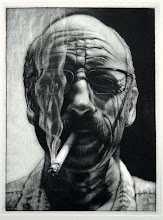
Night In by David Dreisbach

David Dreisbach recently celebrated his 90th birthday. For those of you unfamiliar with Dreisbach's work, he has been an exhibiting artist since 1949 and an educator from 1952 to 1991. He studied with Mauricio Lasansky and Stanley William Hayter. He has exhibited in over 250 one man shows and a very large number of national and international juried and invitational exhibitions and workshops.
David has a lifetime of artistic endeavors and is well respected as an educator who instilled strong artistic commitments in a large impressive group of students. He is an internationaly known expert and innovator in the printmaking field who helped to create technical advances in color viscosity printing.
Joy Peterson of Louisville is the sister of David. She wanted to honor David's 90th birthday by awarding a 'scholarship' gift to a deserving student in printmaking. Joy contacted me for recommendations. I told her that I had several deserving students, but I suspected that since it was to honor her brother that one who had a strong background in etching would be a good match for Joy's intentions. I recommended Wende for this honor and Joy was very excited about that selection. I sent some of Wende's images to her, but I am also going to include some her and invite Joy to visit our blog. Please extend a congratulations to Wende, and enjoy some of her intaglio prints.

Making Love


Transforming


Jelly Fish


Micros


Wende Cudmore holding the card from Joy Peterson

Wende is a senior in the Fine Arts Program and will be graduating in the spring with a BFA in Printmaking. Her work explores nature and it's patterns and those influences on our world, both subtle and overt.  She is currently involved with the tradition of creating "quilts", but rather than employing fabric, Wende is composing her quilts out of printed images from etchings and collagraphs.  They will function as objects rather that the traditional utilitarian bed cover. Wende is also very involved with vegetable papyrus, creating wall hangings, bowls, and most prominently, hats.


Kiwi Hat