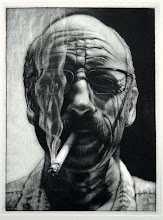
The above relief print by Andy English is part of the portfolio, Walking on Water, that was organized by the print artist Debra Fisher. Although I am not sure if this is a linoleum or wood engraving, clearly the success of the image is the result of careful planning and superb drawing skills, and utilizing the graphic potential of black and white.
Look back at Thursday, August 28, 2008 for a short video on relief printing. Linoleum and wood are the most common surfaces for relief printing, and for those of you who are considering wood, pine and poplar are perhaps the easiest to work with, although the grain of Pine if very hard to very soft and it's sometimes very easy to see cuts that have run away. Be careful cutting into that surface. Poplar is more medium soft and the grain more even than Pine, and it'll hold detail better. Cherry and Pear are very hard and excellent for detail work with fine lines. One of the advantages of wood over linoleum is its ability to be embossed, such as placing a metal washer on the wood surface and tapping it into the wood to create circular shapes. Because of the flexibility of linoleum, such techniques are not as successful
If your idea for the Reconciliation Portfolio has a strong graphic quality, then a relief print may be your surface of choice. What do I mean by strong graphic quality? The ability to communicate your idea through Black and White and the range of optical grays that are the result of careful cutting.